
Can Your Small Business Out-Market the Big Brands?
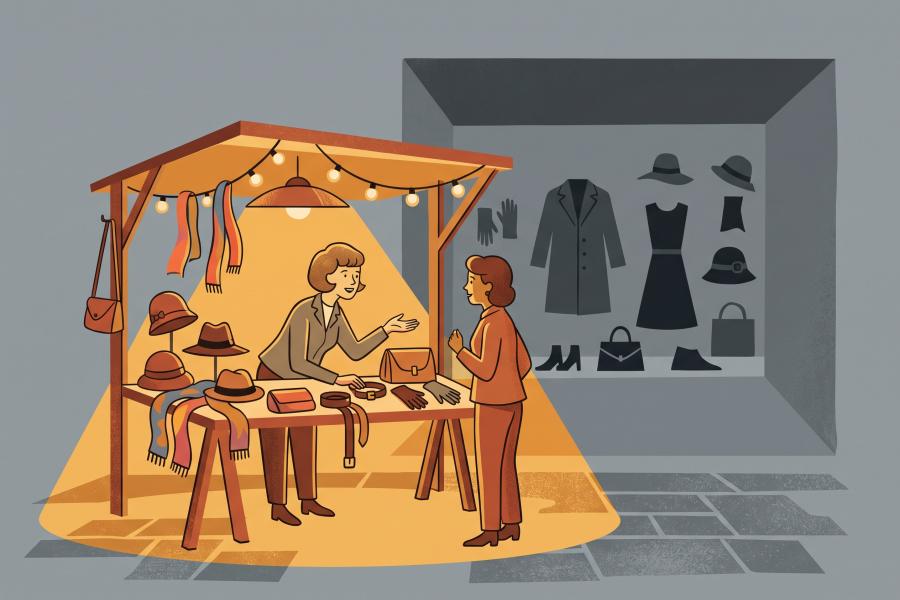
Customers now trust real people far more than polished brand content — and that's a race small businesses are built to win.
You've probably done this yourself. You're scrolling through your feed and a flawless ad slides past — perfect lighting, perfect slogan, perfect stock-photo smile. You don't even register it. Two posts later, a slightly shaky video stops your thumb: a shop owner behind her counter, explaining why she won't sell a product she doesn't believe in. You watch the whole thing.
That instinct — trusting the real person over the polished production — has always existed. What's changed is that it's now measurable, it's growing, and it points in a surprising direction: authentic marketing for small businesses isn't a consolation prize. It's a genuine competitive advantage.
Let's look at why this is happening, and how to make the most of it.
Why does everything online suddenly look the same?
Here's the short answer: AI tools have made it easy to produce competent marketing content at enormous scale. And when everyone uses similar tools with similar prompts, the results start to converge.
Marketers themselves are the first to notice. In a recent industry survey, three out of four said they worry AI-generated creative is making brands look and sound alike — and most reported they'd already seen AI output that closely resembled a competitor's content.
To be clear: AI isn't the villain here. We use AI tools at Allabor, and chances are you do too — for drafts, variations, research, the busywork behind the scenes. Used well, they're a gift to a small team. The problem isn't the tool. The problem is uniformity. When every business in your sector publishes content from the same mold, the content stops meaning anything.
Which raises the interesting question: if sameness is the new noise, what cuts through it?
What do customers actually trust?
People. Specific, identifiable, imperfect people.
Study after study finds that content made by real customers and real employees earns far more trust than content produced by the brand itself. Reviews, unboxing videos, a customer showing how they actually use the product — this is the content people believe.
Why? Think about the difference between a printed flyer and a handwritten note. The flyer might be better designed, but the note gets read — precisely because it couldn't have been mass-produced. Someone took the time. The imperfection is the proof.
Online content works the same way. A face, a voice, a detail only an insider would know — these are signals that can't be faked at scale. And in a feed full of content that was produced at scale, those signals have never been more visible.
The advantage big brands can't buy
Here's where it gets good for you.
A large corporation that wants to "feel authentic" has to manufacture it: hire spokespeople, script casual-looking videos, run approval chains until every trace of spontaneity is gone. You don't have that problem. Your business is already authentic — it just might not be visible yet.
- The owner is the brand. When you talk about your work, nobody has to script conviction into you.
- Your customers are within reach. You know them by name. Asking one for a testimonial is a conversation, not a campaign.
- Your story is true. There's a reason you started this business, and it's more interesting than any tagline an agency could invent.
The pattern shows up in creator marketing too: smaller creators with modest followings consistently see stronger engagement in their communities than big accounts do, because their audiences actually know and trust them. Reach is rented. Trust is owned. You can't fake small.
What you can do this month
None of this requires a budget. It requires showing what's already there.
- Put faces on your business. Yours, your team's. A short introduction video shot on a phone beats a polished animation nobody remembers.
- Film the process, not just the product. How it's made, fixed, chosen, packed. Behind-the-scenes content is trust-building content.
- Let your customers do the talking. Ask happy customers for reviews and short videos, and share them (with their permission). Their words carry weight yours can't.
- Partner small and local. One collaboration with a niche creator your community actually follows will do more for you than chasing a big name.
- Keep AI in the back office. Use it for drafts, scheduling, and variations — and keep the moments where customers meet your brand unmistakably human. Many people are visibly uncomfortable with content that feels machine-made, and they can usually tell.
The good news, in one sentence
So here's the recap: as automated content floods every feed, the things your business has always had — real people, real customers, a true story — have quietly become the most valuable marketing assets there are. The trend doesn't ask you to become something new. It rewards you for showing, honestly and often, exactly what you already are.
Changed